<< Alle Beiträge5 September 2026
You are about to log in to Binance from hotel Wi-Fi, an airport lounge, or while travelling. Should you turn on a VPN? And could doing so get your account banned?
Online answers tend to be extreme. Some say you should never use a VPN with Binance. Others suggest that a VPN lets you trade from anywhere. Neither answer tells the full story.
Using a VPN is not automatically illegal, and simply having one on while accessing Binance is not automatically a problem. It can encrypt the connection between your device and the VPN server, which is especially useful on public networks. But a VPN is not a passport. It cannot change where you live, the documents you use for verification, or whether you are eligible for a Binance service. weiterlesen...
3 September 2026
Your VPN says you are connecting from another country. But your phone may still be telling an app exactly where you are.
That is why a streaming app can show one region while a social app suggests places near your real home. It is why a website may see a foreign IP address while a mobile app asks for your precise location. Your VPN is working. Your phone is simply sharing a different kind of location signal.
A VPN protects your internet connection and replaces the public IP address seen by websites. It does not automatically change the GPS Location reported by your smartphone. weiterlesen...
2 September 2026
Most people turn on a VPN because they do not want their internet provider following every site, app and service they use. That is exactly what a VPN is meant to change.
Still, there is one detail worth being clear about: in most cases, your provider can tell that you are connected to a VPN. It cannot normally read the traffic inside that connection or get a neat list of the videos you watched, pages you opened and messages you sent. But it can see an encrypted connection between your device and a VPN server. Knowing this makes it easier to understand what a VPN protects well, and where its limits are. weiterlesen...
1 September 2026
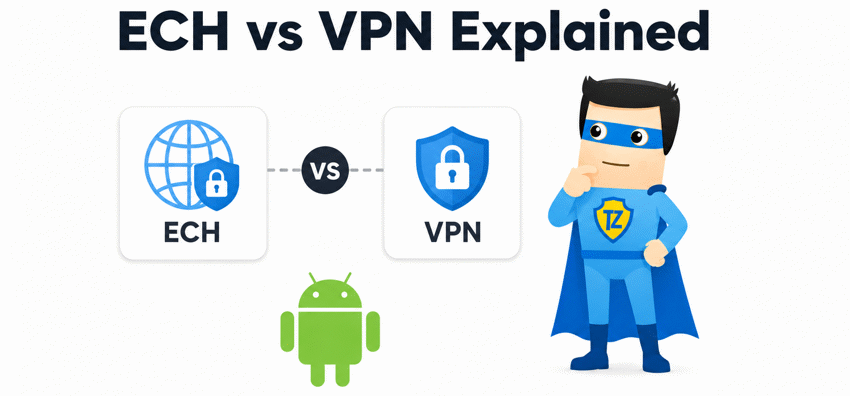
Android 17 is bringing one of the most important mobile privacy upgrades in years. With support for Encrypted Client Hello, or ECH, compatible Android connections can hide the names of websites and online services from internet providers and other network observers.
That sounds remarkably similar to what a VPN promises. If Android can already conceal the websites you visit, do you still need a VPN?
The short answer is YES. ECH closes an important privacy gap, but it does not hide your IP address, replace your location, protect unsupported traffic or create an encrypted tunnel for everything your device sends. ECH and a VPN solve different parts of the privacy problem - and work best together. weiterlesen...
21 August 2026
The movie you searched for last night, the torrent or file you downloaded, the hobby you suddenly became interested in - each action may seem private and unimportant. Put them together, however, and they can reveal your interests, habits, purchases and plans. Add searches about health, finances or relationships, and your browsing history becomes a surprisingly detailed picture of your life.
That information does not always stay between you and your browser. Your internet provider handles your traffic, public Wi-Fi networks carry it, search engines may connect queries to your account, and websites can use your IP address to identify your connection.
When you use torrents, other peers may also see the IP address taking part in the download. A VPN closes one of the biggest windows into this activity. To understand how much it hides, though, we need to separate online traffic from history saved by your browser or accounts. weiterlesen...
17 August 2026
Most VPN users simply browse, stream, message or download files without thinking about incoming traffic. But some use cases, such as BitTorrent, multiplayer gaming, remote access and self-hosted apps, need a way for outside traffic to reach your device.
Port Forwarding provides that capability through your VPN. It can improve P2P performance, make servers reachable from outside and support a range of other advanced uses.
With Trust.Zone, Port Forwarding is available together with a Dedicated IP, giving you a stable VPN IP address that can accept incoming connections on selected ports. weiterlesen...
15 August 2026
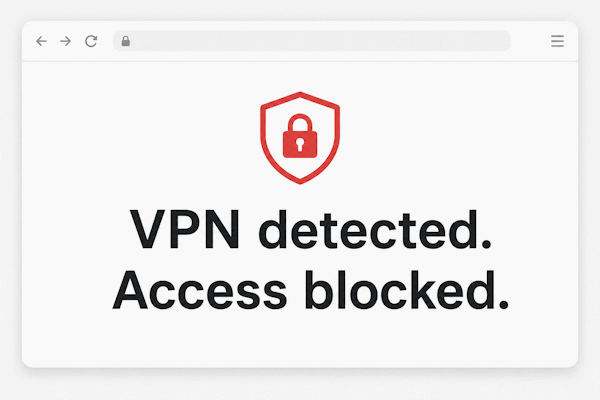
You connect to a VPN, open a website, and suddenly see a CAPTCHA, an access error, or a message asking you to turn your VPN off.
How does the website know?
A VPN hides your real IP address, but it does not necessarily hide the fact that the new IP address belongs to a VPN server. Websites and networks can use several different methods to identify VPN connections — and understanding the difference is important, because not every type of VPN detection works the same way. weiterlesen...
14 August 2026
Cloudflare WARP is built into Trust.Zone VPN V2 as an additional way to establish a more reliable connection.
Most of the time, you can simply connect to Trust.Zone and use the VPN normally. But some ISPs have poor routing, some networks interfere with VPN traffic, and in heavily restricted countries a direct VPN connection may fail completely. This is where WARP can help.
Trust.Zone uses WARP as an additional connection option. Your privacy, VPN server location and VPN connection still come from Trust.Zone. WARP simply provides another route to reach that connection when the normal route is problematic. weiterlesen...
13 August 2026
Before a VPN connection can start working, your device and the remote server first need to establish a connection. This initial exchange of data is called a handshake.
In heavily restricted networks, filtering systems may inspect this initial traffic and try to identify or block certain types of connections before they are fully established.
Handshake Fragmentation, available in Trust.Zone VPN V2, changes how this initial connection data is sent. Instead of sending it as one larger block, the app splits it into smaller fragments. weiterlesen...
13 August 2026
Normally, when you connect to a VPN, all internet traffic from your device goes through the VPN.
But sometimes you don't need every app to use it.
Split Tunneling, available in Trust.Zone VPN V2, lets you choose which applications use the VPN and which connect directly to the internet.
With Split Tunneling, you can control the VPN connection for individual apps. You can send only selected apps through Trust.Zone VPN V2 while everything else uses your regular connection, or do the opposite: keep most apps on the VPN and exclude only the ones that need a direct connection.
Suppose a messaging app or another service is restricted on your network, while everything else works normally. Instead of routing all your traffic through the VPN, you can use Trust.Zone only for that app. weiterlesen...